How One Site Jumped from 150K to 1.5M Traffic 🚀
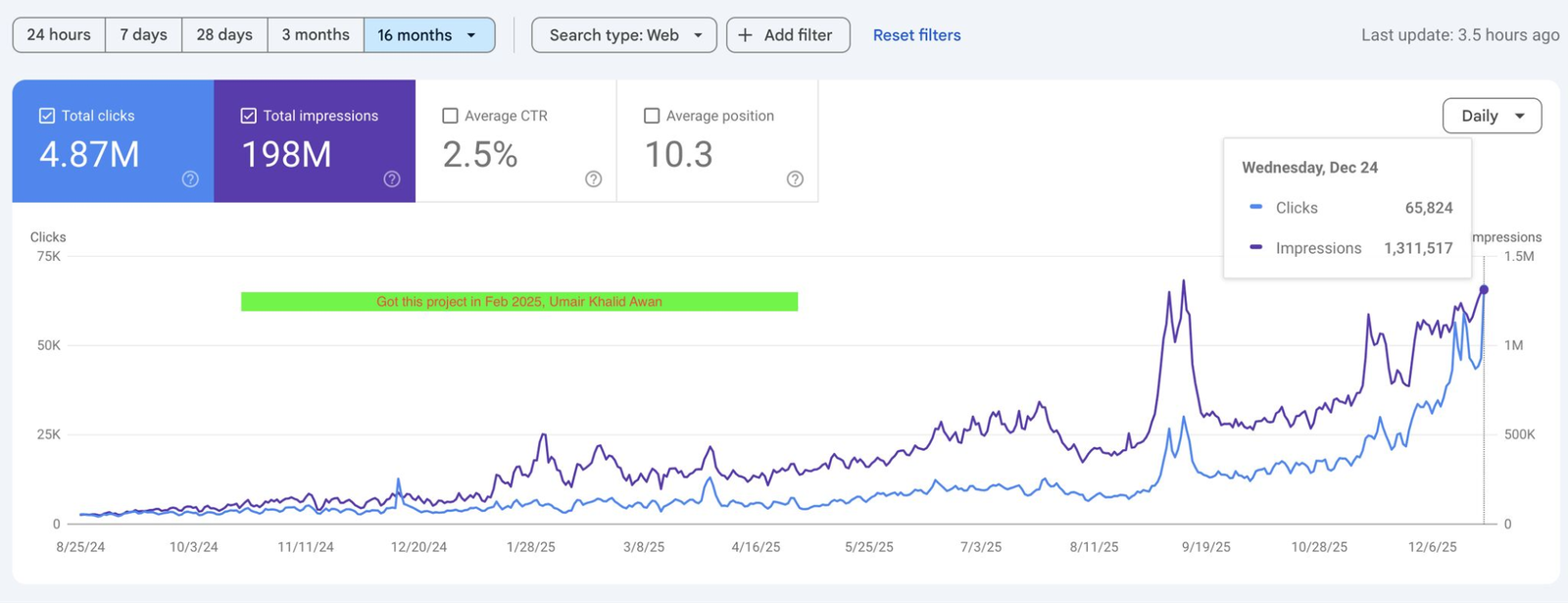
I was scrolling through LinkedIn this week (as we all do 😄) and came across a case study that instantly made me stop.
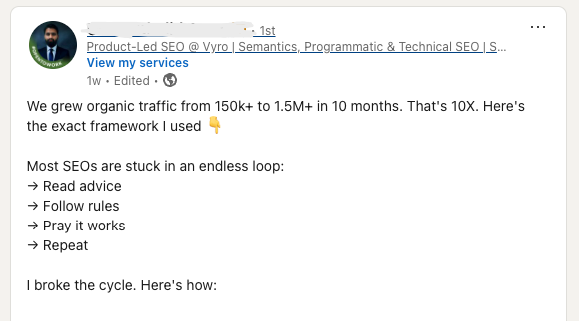
Someone shared how they grew organic traffic from 150K to 1.5M in just 10 months. A clean 10X jump.
No fluff. No “secret hack.”
Just a very honest breakdown of how they approached SEO differently.
So I read it carefully. And honestly? There are some solid lessons worth talking about.
Let me break it down, and then I’ll share my take.
So, What Did They Actually Do?
1. They stopped chasing perfection
Instead of waiting for “perfect” content, they published fast.
Pages went live early.
Performance was tracked daily.
If nothing moved in 60–90 days, the page was updated, merged, or deleted.
They treated SEO like an experiment, not a masterpiece.
What this means: Speed > polish. Data > opinions.
2. They copied what already ranked
No guessing. No “SEO theory.”
They looked at page one results, reverse-engineered the top pages, matched search intent, and improved the structure slightly.
Google was the guide. Not SEO blogs.
What this means: If Google ranks it, it already works.
3. They moved faster than competitors
They published 10–20 pages every month.
If rankings dropped, they fixed it within 48 hours.
Indexing issues were handled the same day.
SEO wasn’t passive. It was reactive and aggressive.
What this means: Consistency and speed compound.
4. They removed everything unnecessary
One keyword per page.
One intent per page.
Thin content? Gone.
Duplicate pages? Merged.
Unclear pages? Deleted.
The site became smaller but sharper.
What this means: Less content, better performance.
5. They questioned “best practices”
They didn’t blindly follow SEO rules.
They asked:
- Do we really need 3,000 words?
- Does keyword density still matter?
- Is this helping users or just filling space?
If something didn’t improve rankings, CTR, or UX, it was removed.
What this means: SEO rules aren’t laws. They’re hypotheses.
What I learned from this case study
Three big takeaways stood out for me:
- Execution beats knowledge
Most SEOs know what to do. Very few move fast enough. - Cleaning content is as powerful as creating it
Deleting or merging pages can drive growth, not hurt it. - SEO works best when treated like a system
Test. Measure. Adjust. Repeat.
No emotions attached.
My honest opinion (should you do this exactly?)
Here’s where I’ll be real.
Yes, this framework works. But it’s not one-size-fits-all.
I agree strongly with:
- Publishing faster
- Learning from page-one winners
- Removing low-performing content
- Focusing on intent over word count
Where I’d be careful:
- Killing pages too quickly for new or low-authority sites
- Publishing at speed without strong topical coverage
- Copying competitors without adding real differentiation
My recommendation
Use this framework as a mindset, not a rulebook.
Move faster. Simplify more. Test aggressively.
But adjust timelines and risk based on your site’s maturity.
This LinkedIn case study isn’t about hacks.
It’s about thinking clearly, moving fast, and letting data lead.
If your SEO feels stuck, the problem probably isn’t strategy.
It’s speed. It’s clutter. It’s hesitation.
And those are all fixable.